Payment channel intelligence is the discipline of identifying which payment methods such as wallets, BNPL providers, alternative payment methods (APMs), and local payment options; a merchant has actively integrated at their checkout, and using that visibility to drive sales prioritization, GTM strategy, and cross-sell targeting. For acquirers, PSPs, and payment facilitators, it is the data layer that turns "we should sell more wallets and APMs" from an aspirational priority into a targeted, prioritized motion.
The opportunity has gotten harder to ignore. Wallets, BNPL, and local APMs now drive a meaningful share of e-commerce volume globally in some categories and geographies, the majority of transactions. The acquirers and PSPs whose merchant base is missing the wallet and APM stack their customers expect lose volume to competitors who do offer it. Conversely, the acquirers who can identify which prospects and existing merchants are missing which methods convert that visibility into prioritized revenue expansion.
This guide explains what payment channel intelligence actually covers, how it works in practice, and what to look for in a solution that supports modern acquirer GTM and product targeting.
Why payment stack visibility drives revenue
Sales teams targeting prospects without knowing their existing payment stack waste a meaningful share of their effort. The merchant a sales rep is trying to win with a generic acquiring pitch may already be processing through a competitor and locked into a multi-year contract. The merchant who looks like a perfect cross-sell for a wallet integration may already have it. The prospect the team is chasing for a BNPL pilot may have launched it three months ago.
Without payment channel intelligence, none of this is visible at the prospecting layer. Sales teams discover it in conversation, after the outreach effort has already been spent. The cycle is structurally inefficient — high activity volume, low qualification rate, and conversion that depends on stumbling onto the right prospects rather than identifying them deliberately.
Payment channel intelligence inverts the model. The team starts with prospects whose payment stacks have been identified; known wallet integrations, known BNPL adoption, known APM coverage and segments by what is missing. A merchant in Western Europe with no Apple Pay and no Klarna is a different prospect than one with both already integrated. The pitch is targeted to the specific gap, the timing is aligned to readiness for new integration, and the conversion rate reflects working a pre-qualified list rather than a generic one.
The same intelligence drives product strategy. Acquirers planning regional rollouts of a new APM benefit from knowing which merchants in the target region currently lack any APM coverage, which already have a competing APM, and which segments would benefit most. Without payment channel intelligence, the rollout is a generic broadcast; with it, it is a prioritized motion against the merchants most likely to integrate.
What payment channel intelligence actually covers
Effective payment channel intelligence is a layered scanning discipline. Each layer addresses a category of payment-stack visibility.
Wallet detection (Apple Pay, Google Pay, Samsung Pay)
The foundation is detecting active wallet integrations at the merchant's checkout. The detection works by scanning for wallet-specific scripts, embedded buttons, branded logos, and merchant tags that appear on actual checkout pages — not on marketing pages, where the wallet may be advertised but not actually integrated.
The distinction matters. A merchant whose marketing site shows an Apple Pay logo is making a marketing claim; a merchant whose checkout page actually loads the Apple Pay JavaScript and renders the button has the wallet integrated. Working detection operates on the second, not the first.
BNPL detection (Klarna, Afterpay, Affirm)
The second layer covers BNPL providers — Klarna, Afterpay, Affirm, Sezzle, Zip, and the regional players that vary by geography. Detection follows the same logic as wallet detection: the active integration is what matters, not the marketing claim. BNPL integrations frequently produce specific script signatures, branded payment options, and merchant ID patterns that make detection reliable when the scanner knows what to look for.
BNPL detection is particularly valuable for cross-sell because BNPL adoption is uneven across geographies and verticals. Acquirers can identify the merchants whose AOV and category profile would benefit from BNPL integration but who currently lack one — a directly actionable cross-sell list.
Local APM mapping
The third layer is local APMs — the regionally important payment methods that vary by geography. iDEAL in the Netherlands, SOFORT in Germany, Bancontact in Belgium, BLIK in Poland, Pix in Brazil, GrabPay in Southeast Asia, M-Pesa in Kenya, and the broader long tail of regional methods. Effective detection covers 100+ global wallets, BNPLs, and local APMs, with regional segmentation that surfaces which methods are relevant for which merchants.
Local APM intelligence is where many generic prospecting tools fall short. A scanner calibrated to global methods will catch Apple Pay and Klarna but miss the local APMs that drive the majority of volume in specific markets. For acquirers operating cross-border, regional coverage is not optional.
Checkout-page scanning at scale
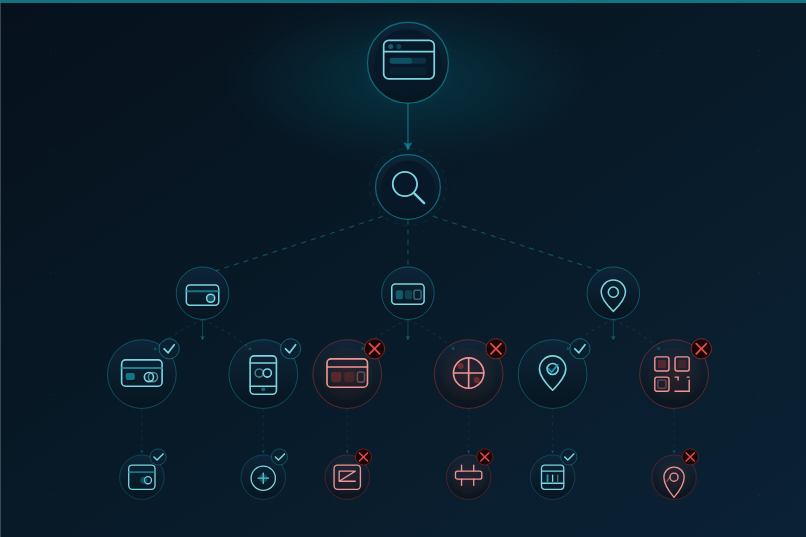
The mechanism that makes the other layers possible. Effective payment channel intelligence runs continuously across active prospect and merchant lists, scanning live checkout pages — not marketing pages — for the full set of integrated methods. The scanning has to identify checkout pages reliably (e-commerce sites do not all use the same URL patterns), handle dynamic checkouts that load methods conditionally, and update findings as merchants change their integrations.
Working scanning identifies BNPL and wallet acceptance in over 60% of mid-market e-commerce leads automatically — a coverage rate that converts payment channel intelligence into a usable input for both sales and product motions.
Vertical and geographic segmentation
The fifth layer is the operational consequence of the first four. Once payment-stack visibility is current across the prospect base, segmentation by supported methods, target region, vertical, AOV range, and growth profile becomes possible. GTM teams can map adoption trends across specific verticals, target campaigns by geography and method gap, and rank prospects definitively by readiness for new payment solutions.
Payment channel intelligence vs. lead generation
A common conflation: that lead generation tools should produce payment channel intelligence as part of their standard output. Some do at a surface level; few do at depth.
Lead generation focuses on identifying and qualifying prospects against acquirer criteria — MCC eligibility, geographic fit, business category, growth signals. It is broad-coverage by design, and the data it produces about each prospect is calibrated to support the qualification decision rather than to support specific cross-sell motions.
Payment channel intelligence focuses on the depth of the payment stack picture for each merchant. The output is a structured map of integrated wallets, BNPLs, and APMs per merchant, designed to support targeted outreach against specific gaps. The lens is depth, not breadth.
The two functions complement each other. Lead generation produces the prospect list; payment channel intelligence produces the targeted angle on each prospect. Acquirers using one without the other end up with either qualified prospects without a clear angle or a clear angle without a qualified prospect base. Working programs run them together.
How payment channel intelligence works in practice
A working payment channel intelligence program operates as a continuous scanning layer feeding into the systems sales and product teams use.
Discovery starts with the target merchant base — prospects from lead generation, existing portfolio merchants, or merchants identified through specific GTM campaigns. Each merchant's checkout pages are identified and scanned, with the active wallet, BNPL, and APM integrations recorded. The scanning runs continuously, refreshing as merchants change their stacks.
Segmentation runs against the scanning output. Merchants are categorized by their integrated method set, by the gaps relative to expected method coverage for their vertical and geography, and by the patterns that indicate readiness for new integration (recent stack changes, growth signals, regional expansion).
Activation pushes the segmentation into the systems sales and product teams already use. CRM enrichment shows the integrated methods alongside the merchant record. Campaign segmentation creates targeted cross-sell lists by method and region. Product analytics consume the same data for rollout planning. The intelligence is operational rather than reportorial.
Wallet and APM signals: what the data is telling you
The most useful payment channel intelligence signals fall into three categories.
Method gap signals are the highest-value sales signal. A merchant whose vertical, AOV, and geography would predict wallet or BNPL adoption — but whose actual checkout has neither — is a high-conviction cross-sell prospect. The gap is the signal; the rest of the merchant's profile is the confirmation.
Stack change signals are the second category. A merchant who recently added a competing wallet, BNPL, or APM is producing a signal that they are actively making payment-stack decisions. Targeting a merchant who has just made a stack change is materially more effective than targeting one whose stack has been static for years, because the merchant's procurement and integration capacity is currently engaged.
Regional pattern signals are the third category. A vertical whose collective payment-stack adoption is shifting — say, a category where local APM adoption is growing materially in a specific region — produces a directional GTM signal that individual merchant data would not. Working programs surface the directional signals as part of the standard output.
The combinations matter. A merchant in a vertical where local APM adoption is growing, located in the relevant region, with a recent stack change indicating active decision-making, and with a current gap in the relevant APM is producing a high-conviction signal that no individual data point would surface alone.
What to look for in a payment channel intelligence solution
When evaluating payment channel intelligence solutions, the questions that matter are about coverage depth, scanning reliability, and integration. Does the solution detect logos, scripts, and embedded tags for 100+ global wallets, BNPLs, and local APMs, or only the global majors? Does it identify active payment buttons on live checkout pages, or does it rely on marketing-page declarations that are frequently inaccurate?
Data freshness is the second filter. The solution should rely on real-time, verifiable website data rather than outdated databases or merchant surveys, with continuous refresh of the scanning so the merchant intelligence reflects current reality. A solution that scans quarterly produces a quarterly view of the market — which is several quarters out of date when the team uses it.
Segmentation depth is the third. The solution should support segmentation by supported methods, target region, vertical, AOV range, and growth profile simultaneously, rather than offering a single dimension at a time. Working sales and product motions need multi-dimensional cuts; segmentation tools that produce only single-dimension views push the analytical work back onto the team.
Integration is the fourth. Payment channel intelligence that produces output only in its own UI creates friction. RESTful APIs, CRM enrichment, and clean integration with adjacent lead generation and product analytics tools are what make the intelligence operational.
How Onlayer automates payment channel intelligence
Onlayer's Payment Channel Intelligence is built specifically for acquirer, PSP, and payment-facilitator GTM motions. The service detects logos, scripts, and embedded tags for over 100 global wallets, BNPLs, and local APMs, identifying active payment buttons explicitly embedded on live merchant checkout or product pages — relying on real-time, verifiable website data rather than outdated databases or inaccurate merchant surveys.
For sales prioritization, the service discovers BNPL and wallet acceptance in over 60% of mid-market e-commerce leads automatically, enabling 70–80% faster sales segmentation by instantly filtering merchants with no current wallet or APM support. Prospects are ranked definitively by their immediate readiness for new payment solutions and integration expansion, so sales teams work from a prioritized list rather than a generic pipeline.
For strategic GTM, the service categorizes merchants seamlessly by supported methods (Apple Pay, Afterpay, Klarna, regional APMs) and target region, and analyzes real-world wallet and APM adoption trends across specific verticals to map the broader market. Product and strategy teams can plan rollouts against the merchants most likely to integrate, and time campaigns to the verticals where adoption is shifting.
The service integrates seamlessly with Onlayer's Lead Generation Service to unify data-driven lead management — converting payment-stack intelligence into qualified, gap-targeted outreach lists. Customized Test Transaction adds depth on the high-priority targets, validating actual payment routing and processor relationships beyond what surface-level scanning can confirm; Online Presence Detection ensures the scanning runs against the merchant's full digital footprint, including alias and undisclosed domains. Combined, the stack turns payment channel visibility from a reporting output into a continuous revenue-expansion input.